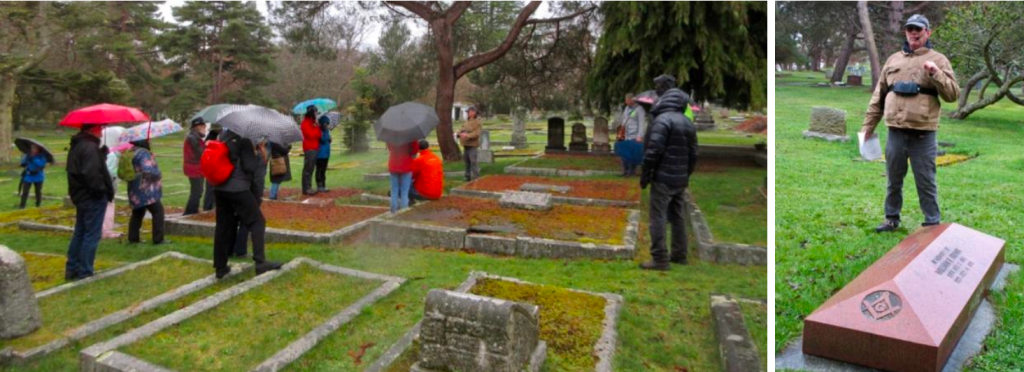
On an overcast March 2, thirty-five people attended Yvonne Van Ruskenveld’s new tour on A Mysterious Monument—the unique grave of Edna Farnsworth. The OCS is now seeking donations for the restoration of this grave (G31 W8) as a special project for 2025. Edna was a nineteen-year-old sex worker whose suicide in 1889 was covered extensively in Victoria and San Francisco newspapers. Drawing on the research of historians Linda Eversole and Patrick Dunae, Yvonne set Edna’s life and death in Victoria’s history as a gold rush supply depot and “sexual emporium”; we visited graves of supporters and opponents of local prostitution. Yvonne explained the unique features of this monument and speculated about who had paid for it.

Photos by Diana Pedersen
Daylight savings began on a cold and wet March 9, but twenty-three hardy souls braved the weather for Glenn Perlstrom’s tour, Twisted History, Part 1—not for the faint of heart. Glenn has long had a fascination with morbid tales and unexpected deaths. He apologized for the gruesome details that were standard fare in nineteenth-century newspaper accounts. The varied causes of death included axe murder, runaway horse-drawn vehicles, smallpox, fishing with dynamite, and, of course, drowning—the leading cause of accidental death in the cemetery.
Photos by Diana Pedersen
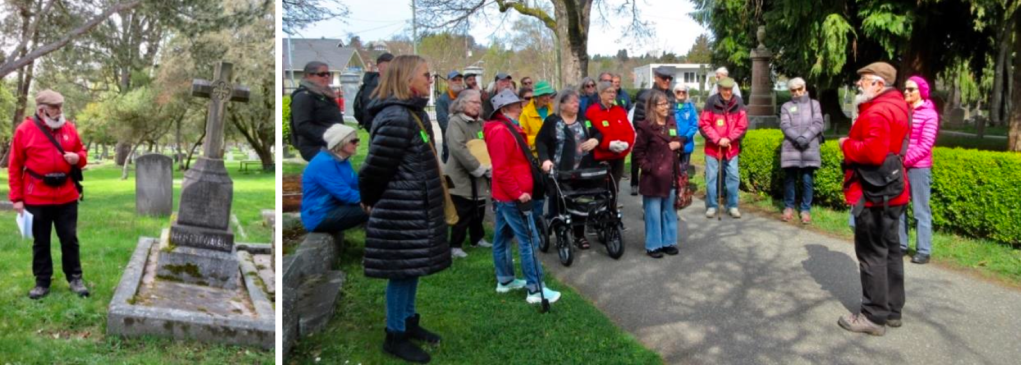
On March 30, weak sunshine finally broke through for the forty people attending a timely tour by John Adams. The Annexationists was retitled We Might Have Been the 51st State in view of President Trump’s recent public musings about annexing Canada. In the late 1860s, the future of the Colony of British Columbia was uncertain. Should it join the distant new Canadian Confederation or the United States? Two petitions supporting American annexation were circulated in Victoria and forwarded to President Ulysses S. Grant, who did not respond. Many of the signatories are buried at Ross Bay Cemetery, including a surprising number of the city’s prominent German immigrants who had spent years living in the US before settling in Victoria.
Photos by Diana Pedersen
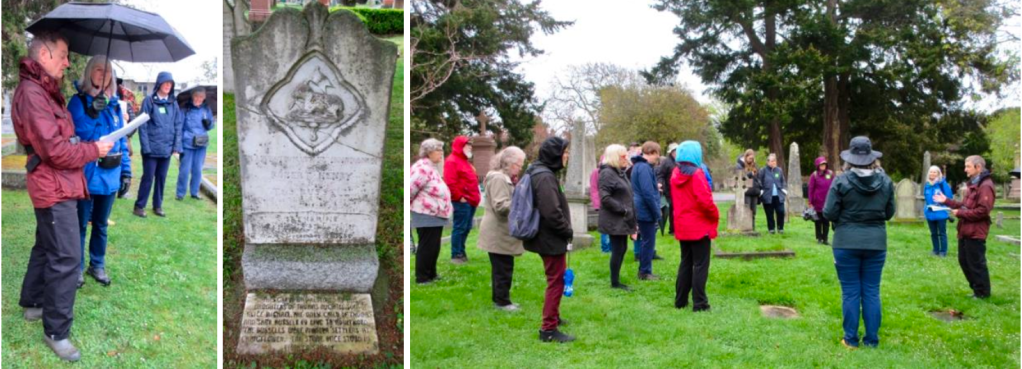
Yet another tour began with heavy rain on April 6; it stopped halfway through. Twenty-five people attended Mike Woodcock’s new tour, Norman Morison: Victoria’s Mayflower, inspired by three voyages of this Hudson’s Bay Company vessel in the early 1850s. Mike drew on extensive genealogical research and the diaries and memoirs of Scottish immigrants who arrived here as indentured labourers and founded some of Victoria’s first settler families; several of their descendants attended the tour. Also mentioned was the grave (T40 W42) of Eliza Norman Morison Wishart (Anderson) Lyall (1852-1926), who was born at sea and named for the ship, the captain, and the captain’s wife; Mike hopes that someday this grave will have a special marker.
Photos by Diana Pedersen
On a sunny and mild April 13, thirty people arrived at Royal Oak Burial Park (ROBP) for a new tour led by Charlotte Clar, Outreach and Volunteer Coordinator at the Sidney Museum and Archives. Many members of early settler families who were prominent in the history of the Saanich Peninsula, including some of the first Black families, are buried at ROBP. Charlotte shared her thorough research and many photographs; her tour referenced well-known features of life on the Saanich Peninsula, including the Saanich Fair, Holy Trinity Church, the Dominion Experimental Farm, Michell’s Farm, and the Sandown Racetrack. The lush grass and sometimes steep hillsides at ROBP were covered with daisies. We hope for a follow-up Saanich Peninsula tour at Ross Bay Cemetery where members of the same settler families are also buried.
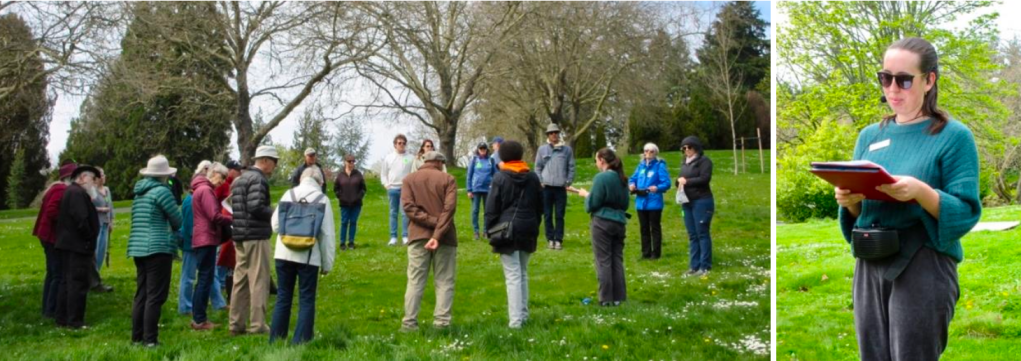
Photos by Diana Pedersen
Easter Sunday, April 20, was a sunny and breezy spring day at Ross Bay Cemetery, where daisies and dandelions, daffodils and shooting stars were blooming in abundance. Twenty-three people attended Alan McLeod’s new tour on The Premiers of Ross Bay Cemetery; RBC, he noted, has “more dead premiers than any other cemetery in BC.” We visited twelve graves—a challenging route that took us all over the cemetery. Some of RBC’s lesser-known premiers served only a few months; Sir Richard McBride was the second-longest-serving premier after W.A.C. Bennett. Alan offered his entertaining judgments about his subjects’ political careers and about their grave markers, which ranged from modest flat stones to the Johnson mausoleum.
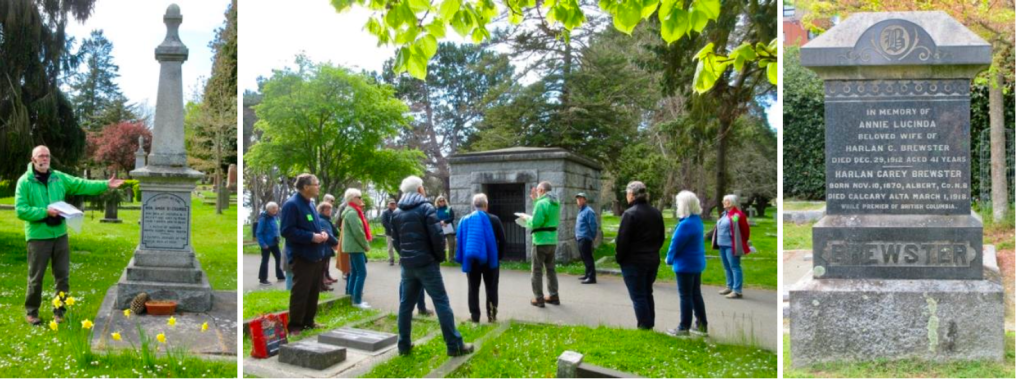
Photos by Diana Pedersen
On a sunny April 27, the early camas was blooming and the Chinese Cemetery provided a spectacular setting for Charlayne Thornton-Joe’s annual tour, this year attended by forty-five people. Charlayne reflected on her long relationship with the OCS and with the cemetery, the latter beginning with visits to her grandfather’s grave for Ching Ming when she was a child. She skillfully wove together Victoria history and the racism that led to the present location of the cemetery; elements of Chinese culture including feng shui (“wind-water”) and Ching Ming; and a fascinating digression about confusion over Chinese names that causes ongoing difficulties for cemetery researchers. The Chinese Cemetery closed in 1950 and it is now a national historic site.
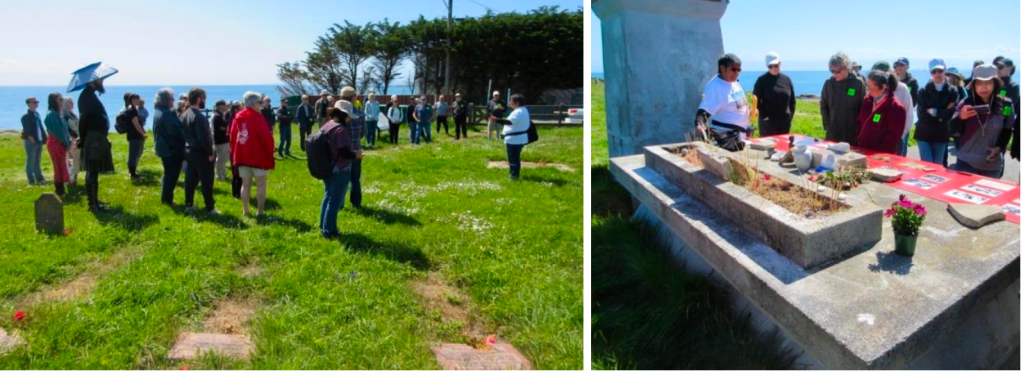
Photos by Diana Pedersen
 Old Cemeteries Society of Victoria