
Diana Pedersen
On Saturday April 5, a beautiful sunny afternoon for a drive, three dozen visitors, including half a dozen familiar faces from the Old Cemeteries Society, arrived at William Head Institution in Metchosin for a special ceremony at one of Greater Victoria’s lesser-known heritage cemeteries. The William Head Cemetery is located on the grounds of a federal minimum-security correctional facility and so is rarely accessible to the public. The occasion was the first-ever Ching Ming event to be held at William Head. Also called Tomb-Sweeping Day, this traditional springtime Chinese celebration honouring the ancestors is explained every year by Charlayne Thornton-Joe at the annual OCS tour of the Chinese Cemetery at Harling Point. It was a privilege to join others at William Head for this unique event.
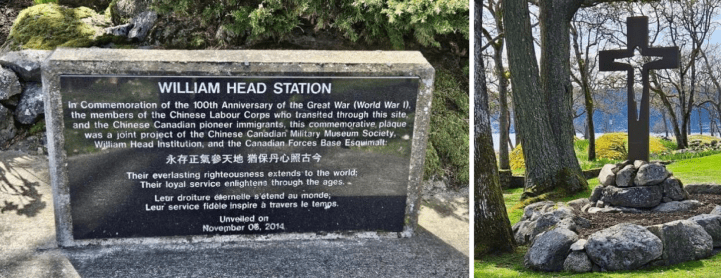
Ching Ming at William Head was conceived and organized by Mary Lindsay, who handled the lengthy negotiations with the staff. Mary’s ongoing project is the initiating of Ching Ming practices to honour the members of the Chinese Labour Corps (CLC) who died in Canada. Recruited to perform paid manual labour for the Allied Armies at the Western Front, 80,000 men from Northern China were secretly transported across Canada between 1917 and 1920, passing through William Head Station. The Commonwealth War Graves Commission has identified twenty-six graves of CLC workers at William Head. Mary approached the Old Cemeteries Society when she needed a principal sponsor for her Ching Ming proposal, and the OCS Board readily agreed to assume this responsibility. Also providing support were the Victoria Canada- China Friendship Association and the Chinese Canadian Historical Society of BC. Several local businesses donated flowers, fruit, cake, and candy for the ceremonial offerings and gifts.
William Head approved a maximum of fifty visitors for the event. Attendees were required to pre-register for vetting and to leave all bags, electronics, and other personal possessions in the parking lot; lockers were provided if needed for wallets and car keys. We handed over our jackets to be passed through a scanner, and then we lined up for a brief introduction to a very efficient Labrador Retriever who specialized in detecting narcotics; none were found. Finally, we were shuttled in small groups to the cemetery, a short drive from the visitor parking area, past the attractive cottage-style residences and other buildings. Throughout this process the William Head staff were welcoming and helpful—not at all intimidating.
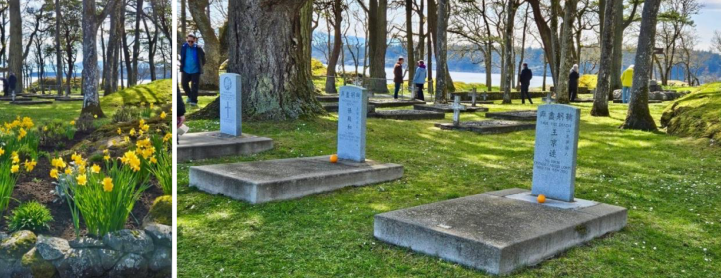
Before the ceremony, we had time to explore the small cemetery and take in its spectacular rural setting. William Head is a peninsula, surrounded on three sides by water, providing a breathtaking view of the Strait of Juan de Fuca and Mount Baker in the distance. The Institution was in the news last year when its aging security towers were removed and replaced by less obtrusive camera towers. The grounds, pathways, and cemetery are carefully tended by some of the residents, who also constructed the benches and picnic tables overlooking the water and planted the beds of daffodils in the cemetery. A platform and chairs were in place for the visitors and an orange decorated every Chinese grave. As we explored the site, about three dozen residents arrived and assembled along the fence behind the chairs; each of them had signed up to participate in the event. Resident Canada geese also observed and performed regular flypasts.
The William Head Cemetery dates to the site’s late-nineteenth-century origins as a quarantine station—an isolated location where ships could be docked for medical inspections and the possible quarantining of passengers and crew. Many of the forty-nine graves, marked by simple stone crosses, belong to anonymous seamen. During the First World War commemorations a decade ago, the contributions of the Chinese Labour Corps received long overdue international attention, and the burial sites of CLC workers were identified and recognized as war graves. The CLC memorial at William Head was unveiled in 2019.
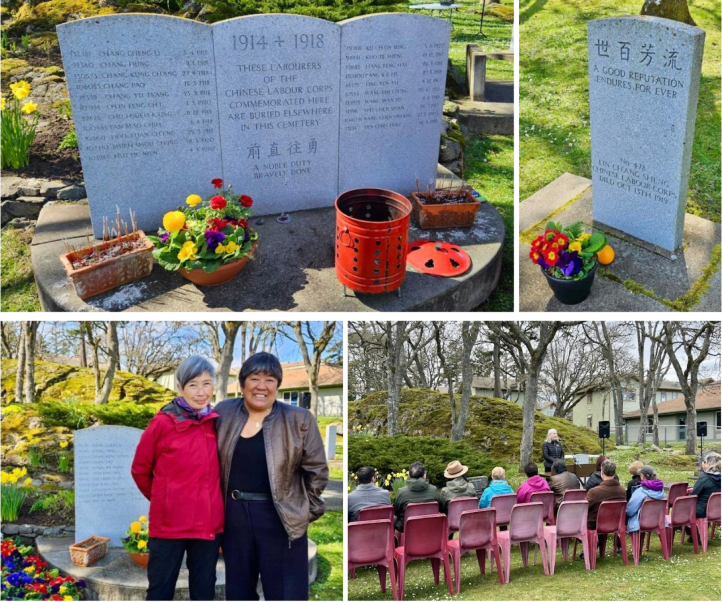
The Ching Ming event began with words of welcome from the Warden of William Head Institution, followed by brief remarks from OCS President Yvonne Van Ruskenveld, expressing the society’s support. Then came an informative talk from Kim Rempel, former staff librarian and now a volunteer at William Head, about the history of the quarantine station and the Chinese Labour Corps. Mary Lindsay spoke about her lived experience of Ching Ming, beginning with her reluctant participation as a child in an Ontario town with a small Chinese community. As she grew older, she became more interested in the tradition and how it could be maintained at the graves of people who had no living family members left to honour the ancestors. Could others assume that responsibility? After volunteering at the Victoria Chinatown Museum, where she met Charlayne Thornton-Joe, she learned about the CLC graves at William Head. Ching Ming, it seemed, had never been celebrated at this isolated cemetery, and Mary began recruiting others to remedy this omission. As she explained, Ching Ming traditions vary from place to place; 105 years after the last CLC worker was buried at William Head, we would help create new ones.
Finally, Charlayne Thornton-Joe issued instructions, emphasizing the centrality of remembrance, reverence, and respect in the performance of Ching Ming rituals. The ceremony centred around the CLC memorial, where flowers had been placed and joss sticks were burning. Visitors were asked to form a line, pair up with one of the William Head residents, take a Stone cuttings May-june 2025 8 donated pot of primulas, place it on one of the graves decorated with oranges, and bow three times in a show of respect. This interlude provided a brief opportunity for introductions and conversation between visitors and residents. Those who wished to participate were then given a piece of joss paper to be lit and tossed into the ceremonial incinerator, sending a prayer or good thoughts into the universe. The names of the CLC workers known to be buried at William Head were read aloud. In conclusion, everyone faced the memorial and bowed three times.
The departing visitors each received a fortune cookie and a gift bag containing a brochure about the event, an apple and an orange, a small Chinese cake, and several types of Chinese candy—all symbolically significant in the celebration of Ching Ming. Staff, residents, and visitors agreed that the day was a success and expressed hopes that it would be repeated—that this was indeed the beginning of a new tradition at William Head. Visitors left with an appreciation of this rare opportunity to visit a beautiful and tragic site whose history has local, national, and international importance. The OCS delegation was especially pleased to learn that this little-known heritage cemetery is being well maintained and enjoyed as a place for privacy and quiet contemplation by the staff and residents of William Head Institution.
 Old Cemeteries Society of Victoria